I'm cleaning up this site today and discovering again that comments don't appear at the end of my posts, and that there are frequently gratifying comments that I wish would appear. So thank you all who post for your interest. I am not ignoring you.

ALICE ON PEACE & JUSTICE
Friday, October 14, 2016


The Costs of War
THIS POST WAS WRITTEN AND POSTED IN 2011, AND I JUST FOUND IT AT THE TOP OF MY POST FEED WITH TODAY'S DATE. ANYWAY, EXCEPT FOR THE DATE, THE POST IS STILL RELEVANT SO I WILL LEAVE IT.
This coming weekend marks the 8th anniversary of the invasion ofIraq Afghanistan
This coming weekend marks the 8th anniversary of the invasion of
Consider health care so costly that many of our citizens can’t afford it even with the Affordable Health Care Act that is under threat, state budgets in so much trouble they are threatening massive layoffs and cuts in essential social services and infrastructure to avoid bankruptcy, a national debt that exceeds $14 trillion, rampant and uncontrolled greed in our financial institutions that caused a massive recession and that show no signs I have seen of reforming or being reformed, an environment increasingly at risk, increased taxes on the lower middle-class while taxes are cut for the most wealthy. No, we can’t afford the mounting costs of resorting to war to resolve our security problems and international disputes.
We study and learn the practice of war. We pour our best resources into improving our military capability. Imagine what would happen if we began to draw down our commitment to war and turned those abilities and resources to learning and practicing peaceful conflict resolution. For that we need moral commitment from citizens and institutions together. A better, more peaceful world will not happen only by individuals just improving themselves, though that is a good and necessary thing to do. But then, like Buddha, or Christ, or Mohammed, the individual needs to take some responsibility for improving the world.
For a time, there was an old bill board on Carmichael Street which said in stark white on black, WAR IS OVER IF YOU WANT IT. I am sorry to see it gone. We need voices, many of them speaking out every where, on billboards, Face Book, Twitter, Blogs, Letters to the Editor. We need moral voices crying out for all the killed, wounded, and displaced by war. We need a vast chorus of voices demanding peace. Please join us at the Aroostook River Bridge
Tuesday, August 2, 2016
LOVE YOUR ENEMIES
ELECTION 2016
Participation in recent conversations on FaceBook and
elsewhere inspire reflection and confession: I don’t know how to love my
enemies. That is the greatest ethical challenge of my life, but in this
election cycle, I even have trouble knowing how to love my friends and how to
avoid making them enemies. Challenges to my refusal to commit to voting for
Hillary Clinton come at me throughout every day from both public and private
sources. With these challenges, I feel powerful temptations to make enemies by lashing
out with name calling, obscenities, withering sarcasm, or condemnations of personal
and trivial weaknesses, real or imagined. Just like is coming from the
presidential candidates and their respective supporters.
Often in the privacy of my own mind or with friends I know
to be sympathetic I give in to these temptations, just like the candidates do. On some level, we
must believe these responses to hurt feelings work, at least to relieve the
hurt temporarily if not to resolve the conflict. Both Donald Trump and Hillary Clinton have
been targets of these kinds of enemy making. And both respond in kind, though
one is much more accomplished, loud, and confident with blasting his many
perceived enemies. Yesterday, I heard a TV news pundit say that daily
relentless attack on Trump is what Clinton needs to do to win the election. It
certainly seems to be working for Trump.
It makes me question my commitment to reasoned argument, respect
for all stakeholders’ viewpoints even when I don’t agree with them, seeking
common ground, and problem solving as the best way, long term, to resolve
conflict and find solutions. That commitment has been my attempt to love my
enemies. Both candidates
believe they have solutions for the public, and neither in this contest has any
interest in resolving conflicts between them. So winning, obviously, has to be
the primary goal. As it is in any competition. That doesn’t seem to be working,
that I can see, in solving the public problems.
All my ethical goals are at odds with winning as the top priority,
and I only know that I won’t vote for Trump nor support him in any way. But how
am I to love him? That is not a trivial question for me. There is not only him
we have to worry about. There are all of his steadfast supporters. If we don’t
find a way to respect the concerns of all those people, we will continue to
have the desperate problems we need to solve.
Wednesday, June 8, 2016
ART SHOW: THE LIFE AND WORK OF ALAN MOUNTAIN
Published in The Star Herald, June 8, 2016:
PRESQUE ISLE -- During the month of May, The Wintergreen Arts Center participated in “May is Mental Health Month” with a show celebrating the life and art of Alan Mountain (1956–2015), a local artist who lived his entire adult life with a disabling mental illness. The Center thanks the generosity of the family of Alan Mountain who donated the proceeds from the sale of his art work and a book he helped to write to be divided equally between the Center and Catholic Charities.
Exhibit Benefits Charity, Wintergreen Arts Center
PRESQUE ISLE -- During the month of May, The Wintergreen Arts Center participated in “May is Mental Health Month” with a show celebrating the life and art of Alan Mountain (1956–2015), a local artist who lived his entire adult life with a disabling mental illness. The Center thanks the generosity of the family of Alan Mountain who donated the proceeds from the sale of his art work and a book he helped to write to be divided equally between the Center and Catholic Charities.
The show
touched hundreds of people and through the generosity of Alan’s family, an
auction of his artwork and the sale of a book he helped to write brought in $2,980
with all proceeds divided equally between Wintergreen and Catholic Charities.
“With this
donation, the family thanks these organizations for the important role they
play in contributing to community mental health,” said Alan’s mother, Alice
Bolstridge.
“I cannot
overemphasize the therapeutic significance of artistic expression in Alan’s
life. And Catholic Charities’ mental health services provided for Alan’s needs
in a variety of ways for most of his adult life: basic survival needs of
housing, food, housekeeping services, and supplies he obtained in their “free
store” that he often used in surprising ways in his art,” Bolstridge said.
Dottie
Hutchins, Wintergreen’s executive director, said, “On May 6, we held a
reception during the First Friday Art Walk which drew a crowd of 125 people,
including several members of Alan’s
family. Alice gave a moving and candid talk about Alan, the importance of art
in his life, and his illness. Her bravery is equaled only by her generosity.
“The family’s gifts—both financial and groundbreaking—are greatly appreciated.”
Dixie Shaw, director of hunger and relief services at Catholic Charities Maine, said, "Catholic Charities is so thrilled to have this support from the family of Alan Mountain. This will go far to provide services for those in Aroostook County struggling with mental illness."
“The family’s gifts—both financial and groundbreaking—are greatly appreciated.”
For more information about Catholic Charities services, visit www. ccmaine.org.
The book Bolstridge and Mountain wrote , Oppression for the Heaven of It, is a “docu-fiction” published under the pseudonym of Moore Bowen. It won the 2013 Kenneth Patchen Award for an innovative novel. For more about the book and to read a copy of Alice’s Gallery talk, visit https://moorebowen.wordpress.com/. The book is available from amazon.com, SPD, Ingram, Baker & Tayler.

ARTS BENEFITS COMMUNITY -- A recent exhibit at the Wintergreen Arts Center focused on the life and work of Alan Mountain, a local artist who struggled with a mental illness. The show and an auction brought in nearly $3,000, which was split equally between the WAC And Catholic Charities Maine. From left are Dixie Shaw, director of hunger and relief services for Catholic Charities; Alice Bolstridge, the artist's mother next to one of her son's works; and Dottie Hutchins, WAC executive director.
Saturday, May 28, 2016
IDEALISM, REALISM, AND VOTING YOUR CONSCIENCE
I feel challenged by a
recent FB conversation thread to defend my "idealism," my conscience,
and my steadfast refusal, against repeated urgings and sometimes outright
bullying, to make any commitment about how I will vote in November if Hillary
Clinton is the Democratic nominee. All such urgings, as in this particular
conversation, argue that a write-in vote for Bernie or a vote for a 3rd party
candidate such as Jill Stein is a vote for Donald Trump. They tell me that
personal idealism and conscience make every such voter "responsible"
for electing the worst possible president, and that "realism" is the
more mature and responsible approach.
First, the issue of responsibility
for election results. Voters who vote their conscience instead of for Hillary
Clinton are responsible for electing Donald Trump? Really? Does the Hillary
Clinton campaign bear any responsibility for being so out of step with so many
Democrats on so many of the issues. Do the authors of a rigged electoral system
bear any responsibility? Does the media who fill their newscasts with attention
to Donald Trump every day bear any responsibility? Do the voters who voted for the sake of
realism against their conscience and ideals for Hillary Clinton in the
primaries bear any responsibility? The issue of who or what is responsible for
the election of Donald Trump is far more complicated than suggested by those
who blame idealism or conscience voters
Putting aside for the moment
all the possible and slippery meanings, philosophically, of “idealism’ and “realism,”
let’s assume that the meanings are what they appear to be on the surface of
this particular argument. Hillary and her supporters argue that Bernie and his
supporters are unrealistic, that his policy proposals are too idealistic to be
workable, and that he doesn’t have the appropriate experience to make them work.
Are these arguments
really valid? Every one of Sanders' policy proposals on issues I care most about are
realistically and successfully practiced somewhere in the world today, or we
already have the know-how and resources to put them into practice. Income equality,
environmental protection, health care, social justice, education, financial and
corporate regulation, political and electoral reform, promoting
a more sensible foreign policy, etc., all
of these issues I am idealistic about, and I believe they are also realistic.
Bernie’s record in the House
and then in the Senate for getting things done is less well-known than Hillary’s
experience as Secretary of State but it is far more impressive in terms of
accomplishing his priorities than Hillary’s congressional experience is. Known
as the “Amendment King,” he has demonstrated his ability to work with others in
congress to make improvements in corporate crime accountability, protecting
pensions, expanding free health care, protecting against nuclear disaster, environmental
protection, protecting veterans benefits, protecting U. S. workers, revealing
corruption in the Military Industrial Complex, and much more. All of these are issues I am idealistic about, and he made progress on them a
reality.
Hillary's representation, on the other hand, of Wall Street while she was in congress is anathema to my ideals, as they resulted in a contribution to the problems of income inequality, poverty, and the disappearance of the middle class. This is realism.
As Secretary of State, Hillary
Clinton clearly has more foreign policy experience in terms of quantity than Bernie Sanders,
but I question the quality and values of that experience. Her record shows she
is clearly more prone to reach for the use of force to resolve conflict than
Sanders, and much more hawkish than I want in a president. Not only her vote on
the Iraq war which she has admitted was a mistake, but also she pushed hard for
a troop surge in Afghanistan. She
strongly advocated for military action against Qaddafi's regime in Libya, She
wanted to arm the rebels against Assad's regime, and she argues for a no-fly
zone in Syria. I am idealistic about peace. All the time I see people around me
coping with conflict in their lives without resorting to physical force or violence.
In everyday “real” life such coping is more the rule than the exception. And it
is much more the general expectation in everyday “real” life than in
international affairs. I believe it is possible to translate that expectation to
foreign policy by putting more emphasis on diplomacy and negotiations as John
Kerry has done with the recent Iran deal to prevent the expansion of nuclear
weapons. He bridged a gap there between idealism and realism.
There does not have to
be an unbridgeable gap between our ideals that so many of us agree on and the
demands of real life. I do not intend to enable with my vote or otherwise those
who believe there must be that gap in the name of realism, and I definitely do
not intend to enable the 1% who stand to gain so much from keeping the gap
unbridgeable. I believe it is my responsibility to do my best to help build bridges,
and I will vote my conscience and ideals in November. Until then I won’t say who
I will vote for, except that it won’t be for Donald Trump.
Friday, May 13, 2016
MORE ON THE ART OF ALAN MOUNTAIN (1956 - 2015)
The art show continues throughout the month of May at the Wintergreen Arts Center in Presque Isle. Bidding continues at the Center and online . For enthusiasm, hard work, and encouragement through all this very moving process, I am deeply grateful to the Wintergreen staff & Board of Directors, Dottie Hutchins and Dione Skidgel, Martha Grant and PIBQ, Brian Bisette @Morning Star Art & Framing, all the attendees and bidders at the reception. Thank you all!
Monday, May 9, 2016
THE ARTIST AND MENTAL ILLNESS
Gallery Talk at Wintergreen Arts Center May 6, 2016
In Civilization and its Discontents, Sigmund Freud says, ‘It is rather the rule than the exception for the past to be preserved in mental life.’ Alan’s art suggests to me endless interpretations about how his character was affected and formed by past traumatic events and in the interplay between disabilities from his illness and his artistic abilities.
My concerns about Alan’s mental and emotional health started when he was very young. At 4 years old, he was diagnosed with nephritis, a kidney disease. He was hospitalized several times over the next 2 years and treated continuously with steroid drugs. The last time he was hospitalized, he was not expected to live, and they tried an experimental treatment, painful injections of albumin into his veins that required a large needle. This treatment worked and he recovered. The steroid treatment continued for another 2 years until he was pronounced cured from the nephritis at 8 years old. The hospital experience was very traumatic for him and for the whole family. Even his pediatrician would get wet with sweat from the strain and tension of injecting a struggling 6-year old while I held him down.
The treatment saved his life. But during this time, I noticed a change in him from an outgoing cheerful little boy to a withdrawn, fearful child which showed in his art even at that young age. Before his illness he loved making colorful pictures with smiling faces and lots of sunshine. By the end of the treatment he was drawing frightful monsters in black and white. I spoke to his pediatrician about my concern for his emotional health. He shrugged off my concern, said, “Kids change as they grow. Just be glad for his recovery from the nephritis.”
No one knows with any scientific certainty what causes mental illness. My family has a history of both bipolar disorder and schizophrenia, so there is quite likely a genetic predisposition. But Alan’s early trauma certainly affected his sense of himself for all of his life. He often asked questions about it, and he would say, “You don’t believe me Mom, but I know I died back then, went to Heaven, went to Hell.
 I recently read a novel in which a character is described as having a moon face and drawing wavy lines on paper. I immediately thought of Alan’s self portrait with wavy lines over his abstract face. The moon face he often expressed in his art is literally tied with that nephritis experience. The steroids gave him a pronounced moon face, and for the first time I made the connection between his moon face in many of his self-portraits and one of his most consistent aliases for himself. He often signed his name on letters as Moonway. We gave that name to the character in the book which he and I collaborated on, and which is for sale here, Oppression for the Heaven of It.
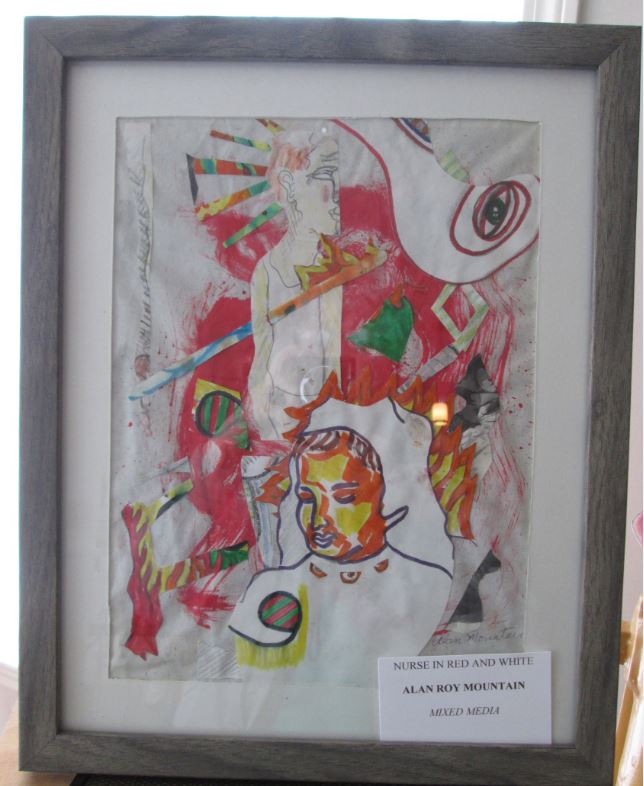
Another image which recalls his early hospital time is the Nurse in Red- Cross colors in foreground with self in background, and the large hypodermic needle. Needles remained a dreaded preoccupation throughout his adult life.
His early monsters morphed into a lifelong preoccupation in his art with demons, serpents and dragons. He never lost his love of color, though, and he eventually integrated his demons into his colorful worlds.


His splashes of color in the Abstracts & Fantasies are crowded with people and creatures, and they reflect tensions with Family, Community, and Cultural values and Expectations. “Feminist Alchemist Seducer& her Family” and “Woman in Green with Religious Figure in Front” remind me of his disturbance at times by my lack of religious belief: the woman in green might be me with my sometimes big curly hair back in the 70s. He would often say about our religious or political differences, “I wish you would believe me, Mom.”

In his art and in his life he was conflicted about couple’s relationships as in the “Couple in Black, White, and Red. Is that a vampire image?
In Western Lapland, they practice a therapy they call open-dialogue which has proved very successful as measured against American medicalized treatment. In this therapy, they believe psychosis arises from severely frayed social relationships. A psychiatrist there, Tapio Salo says, “Psychosis lives in the in-between of family members, and in the in-between of people. It is in the relationship, and the one who is psychotic makes the bad condition visible. He or she ‘wears the symptoms and has the burden to carry them.”
Families are the primal unit of all cultures and the first purveyors of cultural values and expectations that Alan often found too burdensome and contradictory to live up to. I suspect we all experience these tensions in our relationships, but those of us thought to be sane find a way to function and carry on the work of our civilization. People with serious and chronic mental illnesses are said to be dysfunctional; that is in large part how they are diagnosed.
 Many of these pictures might suggest chaotic disorder at first glance, but the more I study them and remember him, the more I believe he used his art for trying to work through the disorder in his mind. He often said about problems and tensions he felt, “I have to work it out.” Sketches in one of the folders labeled Dragons of Madness indicate his preoccupation with good and evil. He tried to reconcile the contradictions in a kind of personal theology, such as “Mary with Sword Confronting Dragons”
 In this landscape, is Christ carrying Alan before he climbs to the cross? Or is Alan carrying Christ from the cross, He
did have delusions of grandeur, and he saw himself at times as some kind of divine savior.
 In his art and writing, Alan tried to develop a grand unified theory of everything like the physicists and religious leaders in all faiths attempt. Alan declared, “Buddha unites” (in “The Feminist Alchemist . . .” above). On a portrait in one of the folders he wrote, “The abolition of war leaves the arts free to unite the classical with the modern. The unity of the cosmos consists not in law but rather in grace, mercy, and love.” He believed Christ and Satan had to reconcile for there to be peace on earth, and he often referred to the poet William Blake’s, “The Marriage of Heaven & Hell.” The pink serpent couple is to me an image of relationship harmony.
 Alan called his creature with the bug eyes on antennae Speam. One of the many demonic creatures in his art, Speam is pictured here being offered a rose from a benign-looking dragon. They are both at the bottom of stepping stones leading to Heaven. I think this is a good image to end this talk.
Do you have questions, observations, interpretations, or stories about his life you would like to share?
Subscribe to:
Posts (Atom)